 |
 |
 |
A sequence of skills
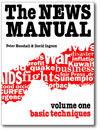
‘The News Manual’ is structured
to help you build your skills in a logical and natural way. The
following is a brief explanation of what to expect.
Chapters 1 to 24 – Basic techniques
In the first third of ‘The News
Manual’ we concentrate on the basic skills of journalism. We start with
a chapter describing in simple terms what news is, then take you
step-by-step through the process of structuring and writing a news
story. We give guidance on writing styles for journalism and the
correct ways of presenting what you have written. Finally we introduce
basic reporting skills such as interviewing and reporting speeches,
skills which every good journalist needs.
The first six chapters are the
most important for journalists new to the profession. Spend some time
on them. Read them thoroughly - several times if necessary - until you
are confident that you can recognise a possible news story and then
write it in a simple straightforward style. The best way to learn any
skill is through practice, so take every opportunity you can to write
news stories. Write and write and write again until your skills are as
sharp as a razor.
Chapters 7 to 15 cover the basic
techniques of researching and presenting news while Chapters 16 to 24
cover basic reporting skills, which you must practise too. They lay the
foundations for most reporting tasks you are likely to encounter as a
journalist.
Chapters 25 to 55 – Advanced techniques
These chapters build on the basic
techniques of journalism which we looked at in Chapters 1 to 24. They
look at more advanced reporting skills, and how they are applied in a
number of special areas of life.
The specialist reporting of
certain areas of life is called rounds reporting. Chapter 26 is
therefore an introduction to rounds reporting and how to do it well.
Chapters 27 to 38 look in detail
at six rounds which make special demands on reporters: politics,
industry & finance, science & technology, religion, minorities
and crime.
Chapters 39 to 45 deal with
special kinds of journalism to handle special situations. We look at
investigative reporting, how to handle stories of death and disaster,
and how to handle stories which are happening as you report them -
breaking stories.
Chapters 46 to 49 are specific to particular media - news pictures, for print media; and writing for radio and television, for broadcast media.
Because newspapers and news
bulletins do not only contain news, in Chapters 50 to 55 we look at
some of the other areas which journalists have to cover - features,
obituaries, reviewing of arts and other creative activity, and sport.
Looking for something?
A
quick way to find what you're looking for in The News Manual is through
the Index. It has more than 1,000 links to concepts throughout the
manuals. Click here:
 |
Chapters 56 to 73 – Ethics and law
In these chapters we look at the
major ethical issues in journalism and at the laws which will probably
affect the way you work.
Chapters 56 to 62 are on ethics
and the final nine chapters of this guide are on law. The two are not
quite the same. Ethics is the consideration of what is right and wrong;
laws are statements of what is permitted and not permitted.
Ethics and law are the two basic
forces which govern the way people behave in societies. They are
usually consistent on issues, because most societies prefer to have
laws which are based on an accepted body of ethics. However, this is
not so in all cases. Laws can allow behaviour which is unethical or
prohibit behaviour which is ethical.
As a journalist, you will often
have to decide what is right and wrong, and to know what is legal and
illegal. Sometimes, you may be faced with the prospect of having to do
what is right, even though the law expects you to do the opposite. We
will discuss some of these situations in detail.
These chapters are unlike the
rest of The News Manual, in that you need to read them through from
beginning to end until you understand all the concepts.
In Chapter 63, we will introduce
the legal issues affecting journalists. For the moment, we make two
important points about the way you use the chapters on ethics.
The first point is that some of
the ethical principles we discuss are so important to professional
journalism that you really have no choice but to obey them. For
example, you must always aim to be as accurate and honest as possible;
you must never deliberately lie to your readers or listeners. You must
always keep your word if you have promised not to reveal the identity
of a confidential source, even if it means going to prison. If you
disregard any of these central principles of journalism, you will not
only have behaved badly as a journalist, but you will also have
undermined the very foundations upon which professional journalism is
built.
The second
point is that many ethical issues are not clear cut. There are times
when the demands to do one thing conflict with the demands to do
another. For example, there are occasions when you can justify invading
a person's private life in order to expose something harmful to
society, and there are other occasions when it is not justifiable.
These decisions can only be made case-by-case after careful thought.
You might like to use Chapters 56
to 73 as starting points for discussing the issues with your
colleagues. Read the chapters, raise the issues and see what
conclusions you reach. You could organise seminars or workshops to
discuss the individual issues. But do not let the process stop at
discussion. Use the outcome to draw up a code of ethics for journalists
in your country. If you already have such a code, discussion of the
issues can lead you to refine, extend or re-interpret it.


कोई टिप्पणी नहीं:
एक टिप्पणी भेजें